

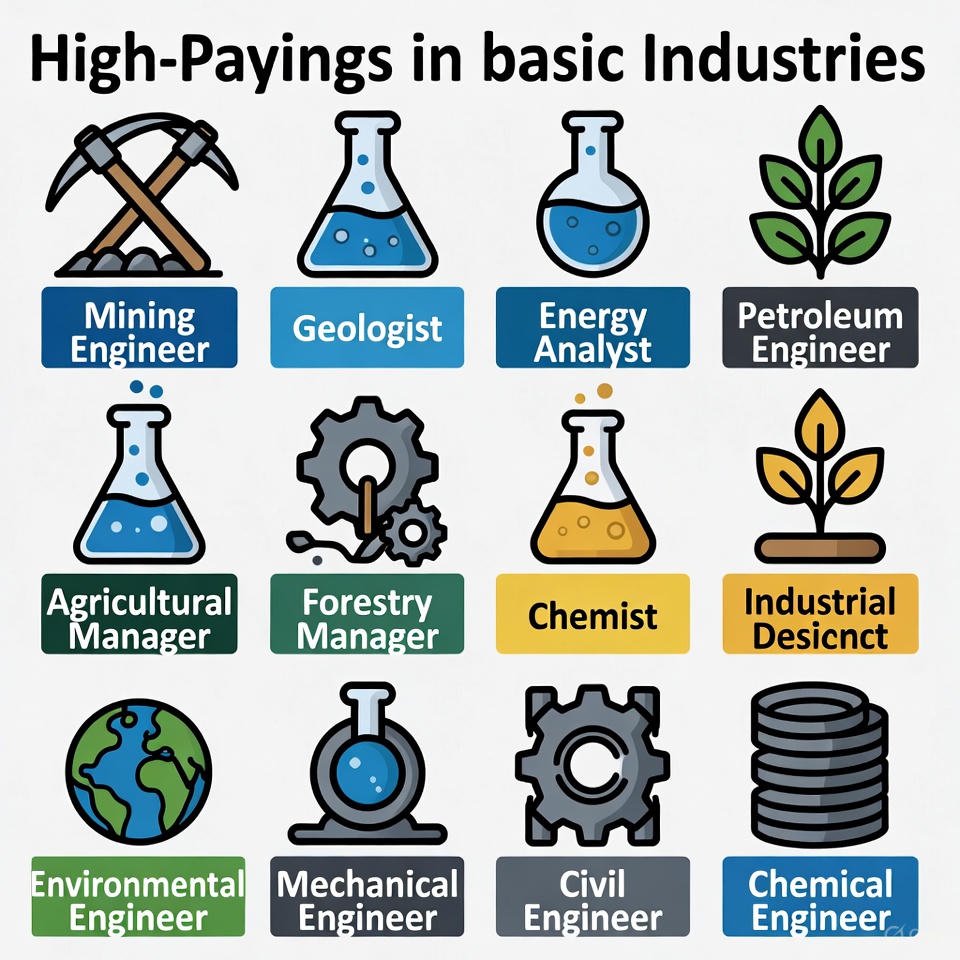
The phrase “basic industries” might sound old-fashioned in an age dominated by apps, AI, and fintech unicorns, but these foundational sectors (agriculture, mining, oil & gas, chemicals, metals, paper, utilities, and construction materials) remain the backbone of every modern economy. In 2025, as supply-chain resilience, energy transition, and infrastructure investment dominate global policy, basic industries are experiencing a powerful renaissance. The question on thousands of job-seekers’ minds is simple yet crucial: Is basic industries have good career potential today?
The answer, backed by data from the U.S. Bureau of Labor Statistics, World Economic Forum, and industry reports, is a resounding yes, provided you choose the right role, location, and company. This 2000-word guide explores why basic industries are quietly becoming one of the smartest career moves of the decade.
What Exactly Are “Basic Industries”?
Basic (or foundational) industries extract or process raw materials that every other sector depends on:
- Agriculture & Forestry
- Mining & Quarrying (coal, metals, rare earths)
- Oil & Gas Extraction and Refining
- Chemicals & Petrochemicals
- Iron, Steel & Non-Ferrous Metals
- Cement, Glass & Building Materials
- Paper & Pulp
- Electric Power Generation & Utilities
These sectors employ over 24 million Americans directly and support another 60+ million indirect jobs. Globally, they represent trillions in annual turnover and are the focus of massive new investment under the U.S. Inflation Reduction Act, EU Green Deal, and similar programs worldwide.
Myth vs Reality: Is Basic Industries Have Good Career Prospects?
Myth 1: Basic industries are dying because of automation and green policies. Reality: While some legacy coal mines and older steel mills have closed, overall employment in modernized basic industries is growing. The International Energy Agency predicts that meeting net-zero goals will require 30 million new jobs in clean energy and critical minerals by 2030.
Myth 2: These are low-skill, low-pay jobs. Reality: Average annual wages in basic industries now exceed $85,000 in the U.S., with many roles paying $110,000–$180,000+ for experienced operators, engineers, and technicians. Overtime, bonuses, and hazard pay often push total compensation well into six figures.
Myth 3: No career progression. Reality: Modern plants use cutting-edge digital twins, robotics, and AI. Employees who master these tools move quickly into supervisory, data analyst, and sustainability roles.
Top-Paying and Fastest-Growing Roles in 2025–2030
- Mining & Geology
- Geological Engineers: $120,000–$190,000
- Mine Automation Specialists
- Critical Minerals Experts (lithium, cobalt, rare earths)
- Oil, Gas & Energy Transition
- Carbon Capture Engineers
- Hydrogen Project Managers
- LNG Terminal Operators ($130k+ with overtime)
- Chemicals & Advanced Materials
- Battery Materials Scientists
- Process Safety Engineers
- Polymer Compounding Technicians
- Metals & Manufacturing
- Electric Arc Furnace (EAF) Operators in green-steel plants
- Additive Manufacturing (3D printing) Specialists for aerospace alloys
- Recycling & Circular Economy Managers
- Agriculture & Food Processing
- Precision Agriculture Technologists (drones, AI, gene editing)
- Vertical Farming Systems Engineers
- Food Safety & Blockchain Traceability Experts
- Utilities & Power Generation
- Wind Turbine Lead Technicians ($85k–$120k)
- Nuclear Decommissioning Specialists
- Grid-Scale Battery Storage Engineers
Many of these roles require only a two-year technical degree or targeted certification, yet they offer salaries rivaling four-year tech degrees.
Why Basic Industries Are Attracting Young Talent Again
- Job Security That Tech Can’t Match You cannot outsource a lithium mine in Nevada or a wind farm in Texas. As nations re-shore critical supply chains, these jobs are politically protected.
- Massive Signing Bonuses and Debt Repayment Companies like Freeport-McMoRan, Nutrien, and ExxonMobil now offer $10,000–$50,000 signing bonuses and up to $100,000 in student-loan repayment for certain roles.
- Real Pathways to $200k+ Without a Traditional Degree A high-school graduate who completes a four-year apprenticeship as an instrumentation technician at a refinery can earn $140,000–$180,000 by age 25.
- Remote & Fly-In-Fly-Out (FIFO) Options Many mining and oil projects pay for all travel, accommodation, and meals while offering 14-days-on/14-days-off schedules.
- Direct Contribution to the Energy Transition Today’s basic industries workers are building the batteries, green steel, and sustainable aviation fuel that will power tomorrow’s world.
Case Studies: Real Careers in Basic Industries
Case 1 – Jasmine, 26, North Dakota Left a marketing job in Chicago to become a Wind Turbine Technician. After a 12-week training course, she now earns $98,000 base + overtime and lives rent-free in company housing.
Case 2 – Miguel, 31, Texas Gulf Coast Started as a chemical plant operator with an associate degree. Five years later, he is a DCS (Distributed Control System) Engineer earning $168,000 and received full relocation when the plant expanded.
Case 3 – Aisha, 29, Nevada Geologist specializing in lithium exploration. Her compensation package includes stock options that tripled in value when her company announced a new mine.
Education and Entry Pathways
You do NOT need a four-year degree for most high-paying roles:
- Community college + co-op programs (e.g., Texas State Technical College, Wyoming’s Energy Technology programs)
- Registered apprenticeships (earn while you learn, debt-free)
- Industry certifications: OSHA 30, API certifications, Siemens Mechatronics, ISA automation
- Military transition programs – veterans are heavily recruited
Challenges You Should Know About
No career is perfect. Basic industries often involve:
- Shift work and overtime
- Remote locations
- Physical demands and safety protocols
- Exposure to weather (mining, agriculture, utilities)
- Cyclical commodity prices (though green-transition demand is smoothing this out)
Yet for every challenge, there is usually higher pay or scheduling flexibility to compensate.
The Global Picture
The trend is worldwide:
- Australia’s mining sector pays FIFO workers AUD 150,000–250,000
- Saudi Arabia’s Vision 2030 is creating 100,000+ jobs in chemicals and minerals
- Chile and Peru offer expat packages for copper and lithium experts
- Germany’s “Industrie 4.0” steel and chemical plants hire English-speaking engineers at €90,000+ starting
Future Outlook 2025–2035
McKinsey, Deloitte, and the World Economic Forum all predict that basic industries will create more net new jobs than tech sectors over the next decade, driven by:
- $9+ trillion in global infrastructure spending
- Electrification and battery-metal demand
- Circular economy and recycling mandates
- Food security investments
So, is basic industries have good career potential? The data says they offer some of the best combinations of salary, stability, and societal impact available today.
Final Verdict
If you want a career where your work literally keeps the lights on, feeds the world, and powers the green transition; if you value six-figure paychecks, rapid advancement, and jobs that cannot be offshored; if you’re willing to learn technical skills and sometimes work hard in challenging environments, then basic industries may be the smartest move you make in the 2020s.
The world runs on the materials and energy these industries produce. The people who produce them are finally being paid — and respected — like it.
FAQ – Is Basic Industries Have Good Career?
Q: Is basic industries have good career in 2025? Yes — excellent pay, high demand, strong job security, and multiple debt-free entry paths.
Q: Do you need a college degree? No. Many roles require only a 1–2 year technical diploma, apprenticeship, or targeted certifications.
Q: What is the average salary in basic industries? U.S. average exceeds $85,000; many skilled roles pay $110,000–$180,000+ with overtime and bonuses.
Q: Are these jobs being replaced by robots? Automation creates higher-skilled, higher-paid roles (robotics technicians, data analysts) rather than eliminating jobs.
Q: Are basic industries bad for the environment? Modern facilities have strict regulations. Many roles now focus on carbon capture, recycling, and renewable energy materials.
Q: Which basic industry pays the most? Currently: upstream oil & gas, lithium/copper mining, and green-steel/chemical engineering roles often top $150k+.
Q: Is it only for men? Absolutely not. Women now hold 20–30 % of new technical roles, and companies actively recruit for diversity.
Q: Can I work remotely? Some planning and data roles yes, but most high-paying field roles involve site work (often with FIFO schedules and premium pay).
Q: Are jobs only in rural areas? Many are near cities (refineries near Houston, steel mills near Pittsburgh, battery plants in Georgia and Kentucky).
Q: How quickly can I start earning good money? With an apprenticeship or technical program: $60k–$90k within 12–24 months; $100k+ within 3–5 years is common.

1 Comment
Pingback: How to Plan the Perfect ellendewittrealestate.com - Financial Technology News | Business News