

Introduction
In the digital age, where sports fandom knows no borders, accessing live games has become a battleground between convenience, cost, and legality. Enter CrackStreams, a notorious online platform that has captivated millions of sports enthusiasts worldwide. For over a decade, CrackStreams has served as a go-to hub for free streaming of major leagues like the NFL, NBA, UFC, MLB, and more. Despite repeated shutdowns and a shadowy existence in the realm of piracy, its clones—such as CrackStreams 2.0—continue to thrive, drawing in users frustrated with skyrocketing subscription fees from services like ESPN or FuboTV.
Why does CrackStreams persist in popularity? At its core, it’s a symptom of broader frustrations in the sports streaming ecosystem. Traditional cable bundles can cost upwards of $100 monthly, while premium services like NFL Sunday Ticket demand an additional $300+ per season. For cord-cutters and budget-conscious fans, especially in emerging markets or among younger demographics like millennials (who admit to pirating sports at rates over 60%), CrackStreams offers a tantalizing shortcut: high-stakes action without the price tag. Launched in the late 2010s amid the cord-cutting revolution, it quickly evolved from a niche aggregator of user-submitted links into a cultural phenomenon, often name-dropped on Reddit threads and TikTok clips as the “holy grail” of free sports viewing. This article delves into the factors fueling its enduring appeal, from accessibility to community-driven resilience, while acknowledging the risks. By the end, we’ll explore sustainable paths forward for fans seeking guilt-free thrills.
The Rise of CrackStreams: A Brief History
CrackStreams didn’t invent sports piracy, but it perfected the art of democratizing access. Its origins trace back to the early 2010s, a time when broadband internet exploded and fans grew weary of blackouts and regional restrictions imposed by broadcasters like Fox Sports or NBC. As streaming services proliferated—Netflix in 2010, Hulu shortly after—sports lagged behind, locked in expensive rights deals that fragmented viewership across multiple platforms.
By 2018-2019, CrackStreams emerged as a response. Founded anonymously (likely by a collective of tech-savvy fans), it aggregated live streams from third-party sources, hosting simple links to embedded players without requiring logins or payments. Unlike clunky torrent sites, it offered near-real-time access, syncing with global events like the Super Bowl or UFC pay-per-views. Its peak came during the COVID-19 pandemic, when lockdowns amplified demand; traffic surged as fans tuned in for NBA bubble games or empty-stadium EPL matches.
Legal troubles were inevitable. In January 2020, the original domain was seized by U.S. authorities for copyright infringement, part of a broader crackdown on piracy rings. Undeterred, mirrors like CrackStreams.me and sister site MethStreams popped up overnight, leveraging VPN-friendly domains and decentralized hosting. By 2024, a renewed enforcement wave—coordinated by the MPAA and sports leagues—took down major iterations, including crackstreams.in in August. Yet, phoenix-like, CrackStreams 2.0 and variants resurfaced, often rebranded with slicker interfaces to evade filters.
This cat-and-mouse game underscores its appeal: resilience. Users appreciate the site’s adaptability, with operators posting updates on Telegram channels or Reddit’s r/Piracy. In 2025 alone, Google searches for “CrackStreams alternatives” spiked 40% post-shutdowns, signaling not decline but evolution. It’s a testament to how piracy fills voids left by legitimate providers, who prioritize profits over universal access.
Key Reasons for CrackStreams’ Popularity
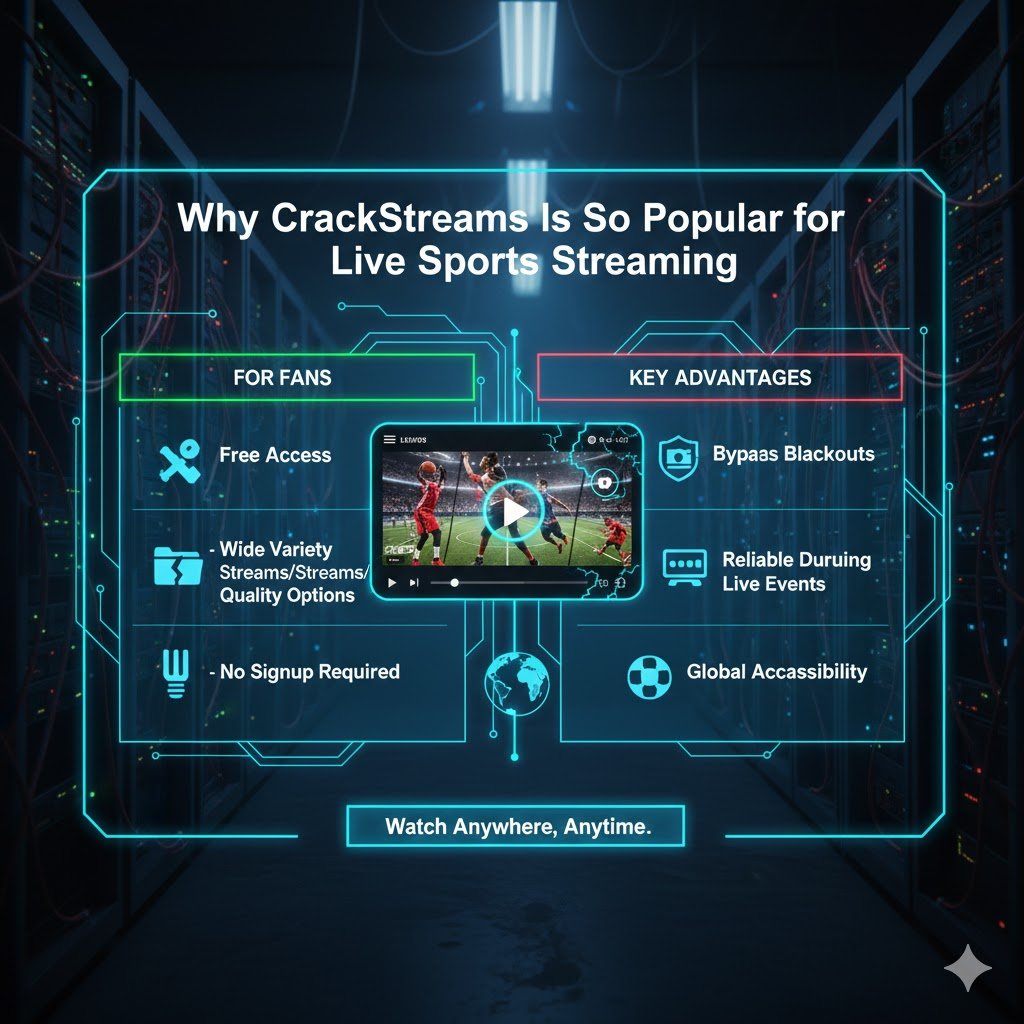
1. Zero-Cost Barrier: Free in a Paywalled World
The elephant in the room—and the site’s biggest draw—is its price: nothing. In an era where the average U.S. household spends $70+ monthly on streaming (per Nielsen), CrackStreams eliminates that hurdle. No credit card details, no trials that auto-renew. For global fans in regions like Southeast Asia or Latin America, where ESPN+ isn’t available or costs equate to a week’s groceries, this is revolutionary. A 2023 Variety survey found 11% of U.S. adults pirate live sports due to cost, with half citing affordability as the trigger—numbers likely higher worldwide.
This freemium model extends to casual viewers too. Imagine a college student catching March Madness or a parent sneaking a World Cup highlight sans guilt. Social media amplifies this: TikToks hyping “free UFC streams” rack up millions of views, turning word-of-mouth into viral adoption. Economists dub it the “Robin Hood effect”—stealing from rich leagues to give to poor fans—though rights holders disagree vehemently.
2. Unmatched Variety and Coverage
CrackStreams isn’t picky; it streams everything from niche MMA bouts to Premier League derbies. Users click categories like NFL or Boxing, scanning 5-10 links per event, often in HD. This breadth outshines paid rivals: DAZN excels in combat sports but skips MLB, while Peacock owns EPL but ghosts UFC. CrackStreams’ aggregator model pulls from global sources, ensuring blacked-out games (e.g., NHL in Canada) remain viewable.
In 2025, with sports rights totaling $100B annually, fragmentation reigns—fans juggle three apps for one Sunday. CrackStreams consolidates, adding chat overlays for real-time banter. For international events like the Olympics, it shines, bypassing geo-blocks that plague VPN-naive users.
3. Simplicity and User Experience
Gone are the days of sketchy forums; modern clones boast clean UIs, mobile optimization, and minimal buffering via adaptive streams. No app download—just a browser tab. Reddit users praise its “plug-and-play” vibe: “Load, click, watch—no BS.” Features like multi-language subtitles and replay buffers enhance immersion, rivaling legit apps.
This ease hooks tech novices too. A 2025 Reddit poll in r/AskReddit showed 30% of respondents favoring CrackStreams for its no-fuss setup over Sling TV’s channel surfing.
4. Community and Cultural Cachet
Popularity begets popularity. CrackStreams thrives on fan ecosystems: Discord servers dissect streams, Twitter Spaces debate lineups mid-game. It’s woven into sports culture—NFL players like Seattle’s Tariq Woolen have admitted using it, normalizing the habit. Memes about “CrackStreams blackouts” flood r/nfl, fostering loyalty.
Post-shutdown, communities rally: When MethStreams fell in 2024, users migrated en masse, sustaining clones via donations or link-sharing. This tribalism—us vs. the paywall—cements its status as a rebel icon.
5. Technological Edge in Evasion
Operators use onion routing, mirror domains, and AI-moderated links to dodge takedowns, ensuring 99% uptime during peaks. Paired with free VPN tips on-site, it empowers users against ISP throttling.
The Dark Side: Risks and Realities
For all its allure, CrackStreams isn’t paradise. Legally, it’s a minefield: Streaming copyrighted content violates DMCA, risking fines up to $150,000 per infraction, though individuals rarely face jail—ISPs issue warnings instead. In the EU/UK, raids on users have led to arrests.
Security-wise, pop-up ads harbor malware; a 2025 Norton report flagged 70% of pirate sites for viruses, leading to data breaches or crypto-mining hijacks. Buffering plagues low-bandwidth users, and streams vanish mid-game. Ethically, it starves creators—leagues lose billions, impacting player salaries.
Alternatives: Steering Toward Legality
Savvy fans pivot to hybrids. Free legal options like Tubi (NFL highlights), Pluto TV (live news/sports), and Plex (user-curated channels) scratch the itch without peril. Paid gems—ESPN+ ($10.99/mo for UFC/NHL), FuboTV ($79.99 for 200+ channels), or YouTube TV ($72.99 with unlimited DVR)—deliver 4K reliability. Bundles like Sling Orange ($40) target budget sports fans. For globals, DAZN ($19.99) rules soccer/boxing.
Emerging tech like league apps (NBA League Pass, $14.99) and free trials mitigate costs. Community watch parties at bars or via Reddit streams offer social fixes.
Conclusion
CrackStreams’ popularity stems from solving real pains—cost, access, simplicity—in a bloated industry. Yet, as crackdowns intensify, its future dims. Fans deserve better: affordable, unified platforms. Until then, weigh the thrills against the threats.
FAQ
Q1: Is CrackStreams legal? A: No, it streams copyrighted content without permission, violating laws like the DMCA. Users risk ISP notices or fines.
Q2: Why does CrackStreams keep shutting down? A: Leagues and authorities target piracy sites for revenue loss; recent 2024-2025 raids seized domains like crackstreams.in.
Q3: What’s the best free alternative? A: Tubi or Pluto TV for legal highlights; StreamEast for riskier full streams (use VPN).
Q4: How can I watch safely if I use it? A: Employ a VPN (e.g., ExpressVPN), ad-blocker, and antivirus. But legal options like ESPN+ are safer.
Q5: Will CrackStreams 2.0 replace the original? A: It’s a clone with similar features but same risks; expect more mirrors as enforcement ramps up.
Q6: How much do sports subscriptions really cost? A: $50-150/month for full coverage (e.g., Fubo + ESPN+); piracy saves money short-term but endangers long-term access.
