

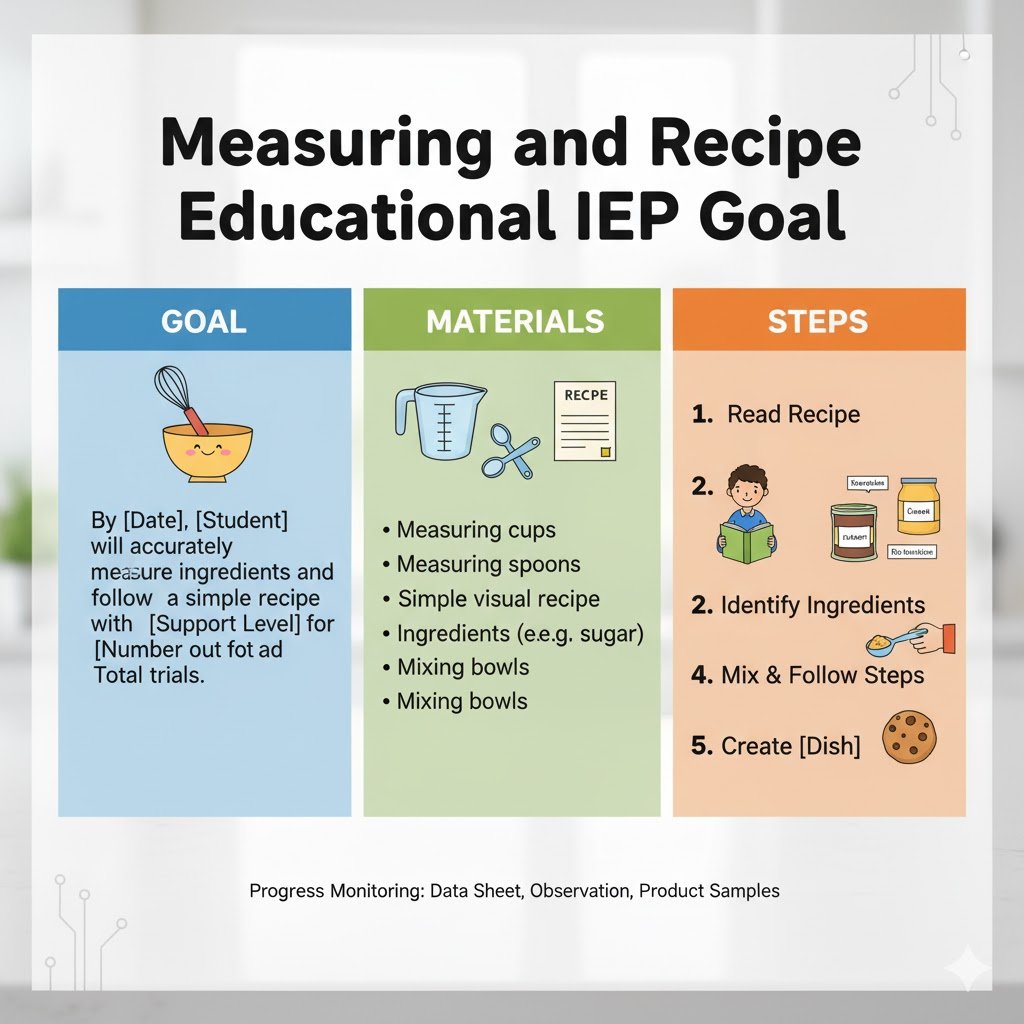
For many students, particularly those with disabilities, the path to independence is paved with practical, life-changing skills. Among the most powerful of these is the ability to prepare a simple meal. Beyond the clear benefits of nutrition and self-sufficiency, cooking is a rich, multi-sensory environment where academic concepts meet real-world application. At the heart of this lies a critical, measurable skill: mastering measurement. A well-crafted measuring and recipe educational IEP goal does more than teach a student how to use a cup and a spoon; it builds a foundation for mathematical reasoning, executive functioning, and personal autonomy that will serve them for a lifetime.
An effective measuring and recipe educational IEP goal is far more complex than it may initially appear. It is not a single skill but a cascade of interconnected sub-skills. It requires a student to decode written text (the recipe), comprehend sequential instructions (the steps), apply mathematical concepts (fractions, volumes), and execute fine motor tasks (pouring, leveling). For students with learning disabilities, autism, or intellectual impairments, each of these steps can present a significant hurdle. A targeted IEP goal breaks down this complex process into observable, measurable, and achievable steps, transforming an overwhelming task into a series of small victories.
Why a “Recipe Following” Goal is a Cornerstone for Independence
The power of a measuring and recipe educational IEP goal lies in its unparalleled functional utility. Unlike many isolated academic exercises, the outcome of this task is immediate, tangible, and rewarding. A student doesn’t just get a score on a worksheet; they get a delicious snack or a meal they can share. This intrinsic motivation is a powerful driver for engagement and persistence.
Furthermore, this goal seamlessly integrates several academic and life skills domains:
- Mathematics: Practical application of fractions (½ cup, ¾ teaspoon), addition and subtraction (doubling a recipe), and understanding volume and capacity.
- Reading and Comprehension: Decoding technical vocabulary, following sequential steps, and interpreting descriptive language (e.g., “packed,” “lightly toasted”).
- Executive Functioning: Task initiation, planning, organization, working memory (holding the step in mind while measuring), and self-monitoring.
- Fine Motor Skills: Scooping, pouring, leveling off dry ingredients, and using tools like whisks and spatulas.
- Science: Observing chemical reactions (baking soda and vinegar), changes in state (melting, solidifying), and cause and effect.
By focusing on a measuring and recipe educational IEP goal, educators and support staff are not just teaching a student to cook; they are providing a holistic learning experience that reinforces core academic curricula in a meaningful context.
Deconstructing the Goal: A Sample and Its Components
A robust IEP goal must be Specific, Measurable, Achievable, Relevant, and Time-bound (SMART). Here is a sample goal and a breakdown of its components:
Sample Annual Goal:
Given a simple recipe with visual supports, a set of measuring tools (cup, spoon), and ingredients, [Student Name] will independently measure and combine wet and dry ingredients with 100% accuracy on 4 out of 5 trials, as measured by therapist data and student work samples.
Let’s deconstruct why this goal is effective:
- Specific: It identifies the exact skill (measuring and combining), the required materials (recipe, tools), and the conditions (with visual supports).
- Measurable: Success is clearly defined as “100% accuracy on 4 out of 5 trials.” Accuracy can be broken down into a checklist: selected correct tool, measured correct amount, leveled off dry ingredients, poured without spillage, etc.
- Achievable: The goal is scaffolded with “visual supports” and starts with a “simple recipe,” ensuring the student can experience success before the complexity is increased.
- Relevant: The skill is directly tied to the student’s post-secondary goal of living more independently.
- Time-bound: As an annual goal, it provides a clear target for the school year.
Building the Scaffolds: From Support to Independence
The journey to mastering this goal requires intentional scaffolding. Students should not be expected to perform the task independently from the outset. Effective instructional strategies include:
- Task Analysis: Breaking the recipe down into its smallest steps (e.g., 1. Get the 1-cup measure. 2. Place it on the counter. 3. Scoop flour into the cup. 4. Use a knife to level the top.).
- Visual Supports: Using picture-based recipes, color-coded measuring cups, and step-by-step photo guides. This is especially helpful for non-readers and students with autism.
- Video Modeling: Showing a short video of an expert or peer correctly performing the measuring step before the student attempts it.
- Hand-Over-Hand Guidance: For students with significant motor challenges, initial physical guidance can help build muscle memory.
- Use of Adaptive Tools: Introducing angled measuring cups (for viewing from above), magnetic bowl holders, and easy-grip utensils to reduce physical barriers.
The ultimate aim is to systematically fade these supports until the student can perform the task independently, as outlined in the goal.
The Ripple Effect: Beyond the Kitchen
The benefits of achieving this measuring and recipe educational IEP goal extend far beyond the kitchen. The self-confidence gained from creating something tangible is profound. Students who master this skill often show improved self-esteem and a greater willingness to try other new tasks. They learn the invaluable lesson of learning from “failure”—if the muffins didn’t rise, we can problem-solve together to figure out why (e.g., was the baking powder old? Was the measurement incorrect?).
This goal also fosters social and communication skills. Cooking is often a communal activity. A student who can contribute to preparing a family meal or a snack with peers is participating in a shared, meaningful experience. They learn to collaborate, share tools, and take turns, building crucial social connections.
Conclusion: A Recipe for a More Independent Future
An IEP goal focused on mastering measurement in recipe following is a powerful investment in a student’s future. It is a quintessential example of a functional life skill that is both academically rigorous and personally empowering. By meticulously teaching this skill, educators are not just checking a box on an IEP form; they are equipping students with the competence and confidence to feed themselves, to understand the mathematics that govern their daily lives, and to take a significant step toward self-reliance. In the end, this goal provides students with more than just a meal; it gives them a recipe for a more independent and fulfilling life.
Frequently Asked Questions (FAQ)
Q1: My child has significant fine motor challenges. How can they participate in a measuring goal?
A: Absolutely. The goal can be adapted through the use of specialized tools. Angled measuring cups allow for easy viewing without tilting. Dycem mats or magnetic bowls can stabilize equipment. For pouring, smaller containers or pitchers with easy-grip handles can be used. The focus can shift to directing an adult or peer (“tell me which one to use”) if physical participation is extremely limited, targeting the cognitive and identification aspects of the skill.
Q2: What does a “simple recipe” look like to start with?
A: A great starting point is a “no-cook” recipe with minimal ingredients and steps. Think a “Ants on a Log” (celery, peanut butter, raisins) or a yogurt parfait (yogurt, granola, berries). This removes the variable of heat and allows the student to focus entirely on the measuring and assembling process. Visual recipes with clear pictures for each step are highly recommended.
Q3: How is “accuracy” actually measured and recorded?
A: Accuracy is best tracked using a simple, standardized data sheet that breaks the measuring process into observable steps. For example, for measuring 1 cup of flour, the checklist might be: (1) Selected 1-cup measure from set, (2) Scooped flour into cup, (3) Leveled with a knife, (4) Poured into bowl without significant spillage. The therapist or teacher marks a +/- for each step on each trial to collect objective data.
Q4: Can this type of goal be addressed in a virtual or homeschool setting?
A: Yes, effectively. For virtual learning, the teacher can send a “recipe kit” home with pre-portioned ingredients or use a common set of ingredients the family has on hand. The student can then follow along via video call, with the teacher providing live feedback. The same data collection methods can be used by a parent or guardian with guidance from the teacher or therapist.
Q5: How do we make this goal challenging for a student who has mastered basic measuring?
A: Once a student has mastered basic measuring, the goal can be elevated by:
- Introducing more complex recipes with more steps and ingredients.
- Incorporating time-management components (e.g., “prepare this within 20 minutes”).
- Adding math challenges like doubling or halving a recipe, which requires computational skills.
- Moving from following a recipe to planning a simple, balanced meal, integrating nutrition education.
