

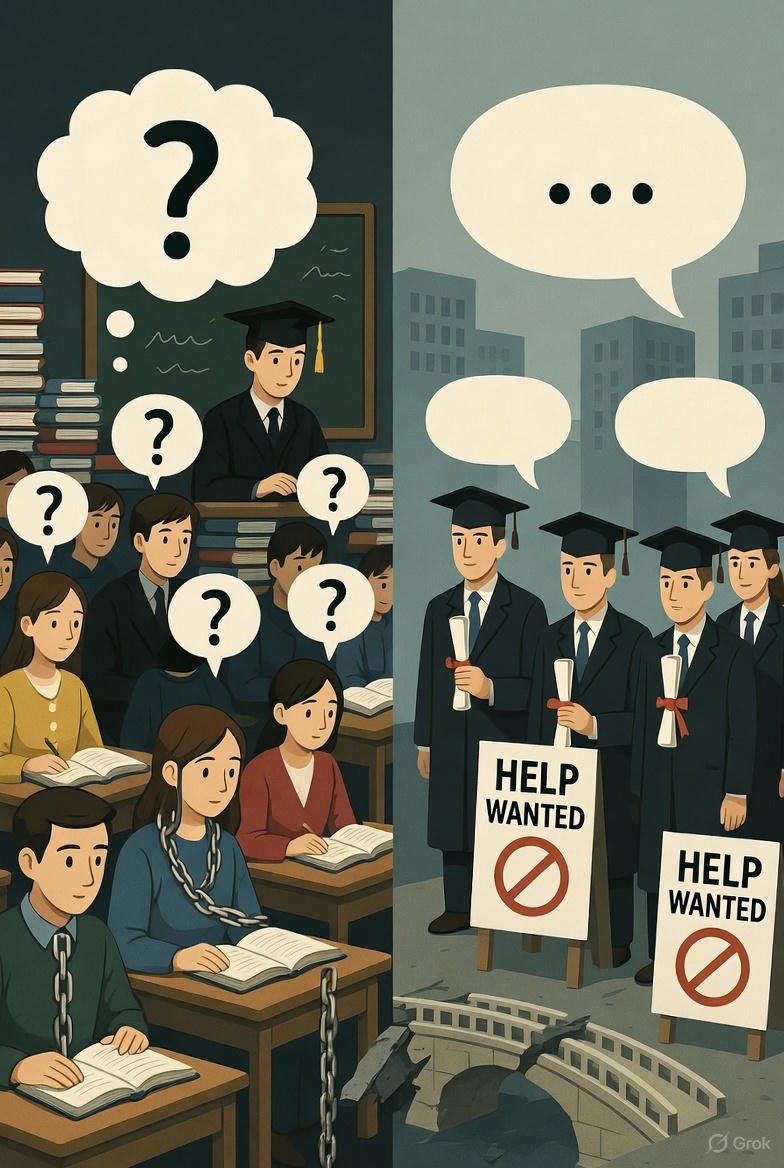
A few days ago, a young electrical engineer shared his frustration with me. Despite a degree earned through his parents’ sacrifices, he had been jobless for four years. As he recounted endless applications and rejections, I listened patiently. Then I asked: “Can you wire your own house?”
He was stunned. “I’m an engineer, not a technician—that’s manual work.” When I probed what engineers actually do, he said they supervise others. “But how can you supervise what you can’t do yourself?” He tried to explain with examples, but none held up.
This isn’t isolated—it’s a national failure. Pakistan’s education system costs families millions in fees and lost time, yet delivers little more than a certificate. Graduates often take a decade to recoup costs through meager salaries. More alarmingly, degrees don’t equate to competence: MBBS holders aren’t always capable doctors, engineers aren’t skilled practitioners, and LLB graduates aren’t ready lawyers.
The core issue? Rote learning. Success depends on memorization, exam-day recall, syllabus coverage—or sometimes cheating, still rampant enough to require police at centers.
Medical education exemplifies this: Hundreds of thousands take the MDCAT annually (around 140,000-200,000 recently), facing fierce competition. Private colleges charge Rs. 1.2-1.9 million yearly in tuition alone, plus extras pushing totals to Rs. 3-5 million. Yet even top graduates often lack confidence to treat basic cases, outshone by experienced assistants.
Similar patterns plague law (new lawyers clerk for years), engineering (jobless despite degrees), and business (MBAs starting entry-level without experience). True learning happens post-graduation, through decades of real-world struggle—a model obsolete globally.
In advanced systems (Europe, US, Australia), practice leads: workshops for engineers, hospitals for medics, courtrooms for lawyers, mandatory businesses for MBAs.
We vilify “fake” degrees (bought or forged) but overlook that diligent students—attending classes, scoring 90%+—often gain no expertise. Ironically, some with invalid credentials excel through hard-earned skills, later legitimizing paperwork.
The recent case of Justice Tariq Mahmood Jahangiri underscores this. Appointed to the Islamabad High Court in 2020, he handled hundreds of cases competently for years. Yet in December 2025, the IHC ruled his LLB invalid (due to enrollment discrepancies, name variations, and past exam misconduct), removing him on December 18. He had practiced law successfully for decades. This prompts reflection: How did he build expertise without a “valid” degree? And why did scrutiny intensify amid broader judicial controversies?
As former CM Nawab Aslam Raisani said in 2010: “A degree is a degree, whether real or fake.” Harsh, but events like this reveal how performance often outweighs paperwork—yet the system obsesses over the latter.
Universities collect lakhs but impart few skills. Degrees, real or questionable, hold superficial value.
Reform requires prioritizing practice: An electrical engineer wiring safely, a doctor treating confidently, a lawyer arguing independently. Until then, institutions risk becoming mere “money-making machines,” trading expensive papers for unfulfilled potential. True progress demands skill-based education that prepares youth for reality, not just exams.
Frequently Asked Questions (FAQ)
1. What is the main criticism of Pakistan’s education system in this article?
The article argues that the system focuses on rote memorization and theoretical knowledge, producing graduates who lack practical skills and real-world competence, despite expensive degrees.
2. Why does the author use the example of the unemployed electrical engineer?
To illustrate how engineering education fails to teach hands-on skills—like basic wiring—leaving graduates unable to perform or supervise core tasks effectively.
3. How much do private medical college fees typically cost in Pakistan?
Annual tuition in private medical colleges ranges from approximately Rs. 1.2 million to Rs. 1.9 million, with total costs (including additional expenses) often reaching Rs. 3-5 million per year.
4. How many students typically appear for the MDCAT exam?
Around 140,000 to 200,000 students participate annually in the Medical and Dental College Admission Test (MDCAT).
5. Is cheating still a major issue in Pakistani exams?
Yes, cheating remains widespread, with reports of police deployment at centers, paper leaks, and use of unfair means in board exams, matric/intermediate, and even entrance tests like MDCAT.
6. What happened to Justice Tariq Mahmood Jahangiri?
In December 2025, the Islamabad High Court ruled his LLB degree invalid due to irregularities (name discrepancies, enrollment issues, and past unfair means), declaring his judicial appointment unlawful. He was removed from office on December 18, 2025, and de-notified shortly after.
7. Does the article claim there’s no difference between real and fake degrees?
It argues that in practice, many “genuine” degrees lack practical value, while some with questionable credentials succeed through real skills, making the distinction superficial in the current system.
8. What global comparison does the article make?
It contrasts Pakistan’s theory-heavy approach with systems in Europe, America, and elsewhere, where practical training (workshops, hospital rotations, courtroom practice) precedes or integrates with theory.
9. What reform does the author dream of for the education system?
Universities should produce practically skilled graduates: e.g., engineers who can perform basic tasks, doctors who can treat patients confidently, and business students running enterprises.

13 Comments
Pingback: diflucan for yeast
Pingback: lisinopril 10 mg price
Pingback: cefixime
Pingback: actigall medication
Pingback: reglan for nausea
Pingback: ivermectin for people
Pingback: azithromycin 500 mg
Pingback: dapoxetine where to buy
Pingback: doxycycline antibiotic
Pingback: levitra generic
Pingback: finasteride for hair loss
Pingback: diflucan over the counter pill
Pingback: tetracyklina